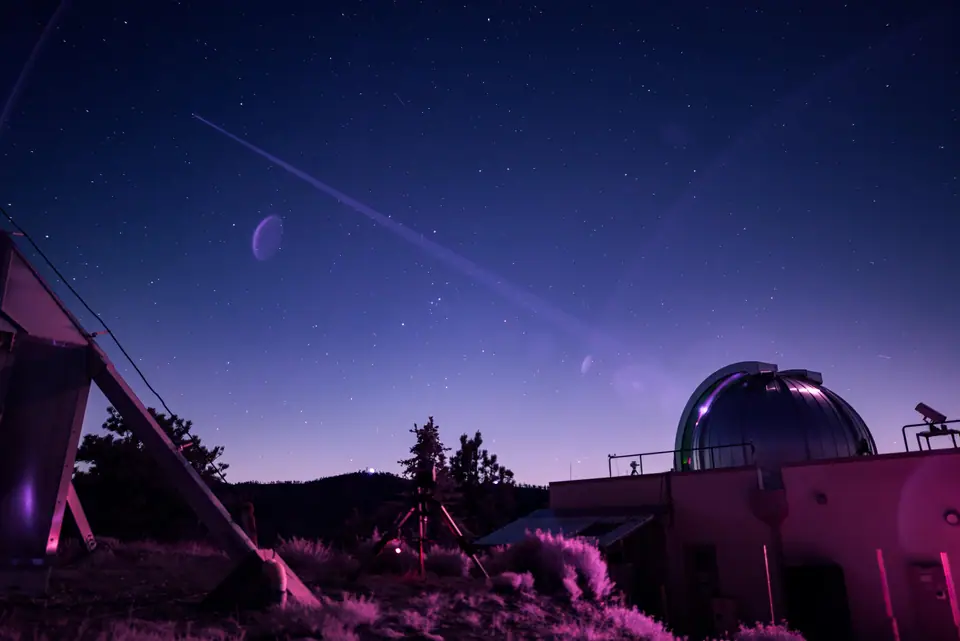
On 2 June 2025 at Table Mountain, an infrared-sensitive camera recorded a line of light above the observatory dome. The laser was pointing towards Psyche, then about 230 million kilometres away. The photograph shows the beam sent from Earth. The visible streak is not the signal received from the spacecraft.
In December 2023, the test had already sent a fifteen-second video of a cat called Taters in the opposite direction. The footage had been loaded before launch. The question was what would happen to the data in transit over a distance measured in minutes, even at the speed of light.
Why send data by light?
Radio waves and infrared light are both electromagnetic radiation. Either can carry data. In a suitable optical system, the available bandwidth makes it possible to encode many bits per second. A narrow beam concentrates energy in one direction, which matters when distance would otherwise leave very little signal at the receiver.
That concentration comes at a cost. The spacecraft has to aim the beam at the point where Earth will be when the light arrives. The ground station must distinguish signal photons from background photons. DSOC used a ground beacon to acquire the link and a telescope with a sensitive detector to receive the return signal.
The distance record and the speed record
The peak of 267 megabits per second was demonstrated at about 31 million kilometres. In April 2024, at roughly 226 million kilometres, the system reached a peak of 25 Mbps with test data. In the same test, it also sent some spacecraft data by laser while the normal radio channel operated in parallel.
In June, at about 390 million kilometres, the reported maximum was 8.3 Mbps. The most distant test, in December 2024, received data at 494 million kilometres. At that distance, light takes about 27 and a half minutes to travel one way. That delay is a different measurement and does not disappear when the data rate increases.
| Test | Approximate distance | Result |
|---|---|---|
| Test video, December 2023 | 31 million km | 267 Mbps |
| Test data, April 2024 | 226 million km | 25 Mbps |
| June 2024 test | 390 million km | 8.3 Mbps |
| Greatest distance, December 2024 | 494 million km | Reception confirmed |
The atmosphere is part of the link
The beam passes through air before leaving Earth or reaching the telescope. Clouds can interrupt the link. Turbulence and background light make reception harder. A station in another region may have different conditions, but it still needs suitable equipment, geometry and a contact opportunity.
The demonstration ended on 2 September 2025, on the 65th pass, at roughly 350 million kilometres. Ground terminals received 13.6 terabits over the course of the project. Psyche continued its own mission and flew past Mars in May 2026.
What could change on a future mission?
Greater transmission capacity could allow more images and measurements to be sent per contact. A future mission to Mars would have to decide which traffic can wait for an optical window and which functions need a more predictable route. The experiment demonstrated a technology. Its operational use will depend on the missions and ground stations that adopt it.
ScopeLink’s QR-code test studied a problem on the scale of a screen. DSOC used a laser and specialised receivers over interplanetary distances. The two share a practical question: how much information can still be recovered after the signal travels through a medium that can weaken or distort it?
Editorial correction · . The table and text were corrected to identify the 25 Mbps reached in April 2024 as a peak measured with test data and to give the June 2024 contact distance as about 390 million kilometres.
Sources and references
- JPL · Final results of the DSOC demonstration
- NASA · DSOC mission and demonstration timeline
- NASA · Test at 226 million kilometres
- JPL · First-phase results
- JPL · Psyche’s flyby of Mars
- JPL · Infrared photograph of the beam, PIA26661
Sources reviewed on .