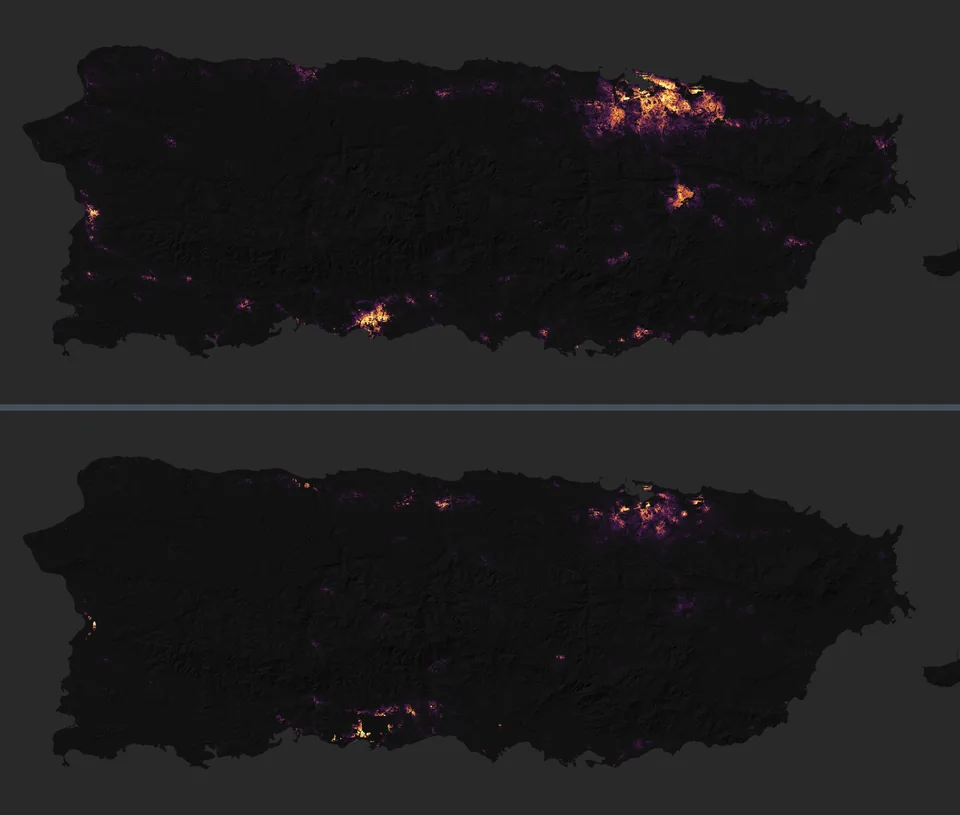
On the morning of 21 September 2017, after Hurricane Maria, the US communications regulator reported that 95.2% of Puerto Rico’s cell sites were out of service. It was a snapshot of that morning. Days later, NASA’s night-time imagery showed another side of the disruption. Large areas that had lit up before the storm lay dark.
There is a distance that is hard to measure between seeing “no service” and telling someone “I’m here”. It starts near the phone, within the few metres where another device might hear it. It ends with the person who needs to know. Getting between those two points may take a different network from the one we rely on every day.
What two phones can do
Bluetooth and Wi‑Fi let certain apps discover nearby devices and exchange data without an internet connection. Google’s Nearby Connections documentation describes that kind of link. An app must support device discovery and connection. Its link reaches only as far as the phones can stay in contact.
Briar illustrates a practical design choice. It can synchronise over Bluetooth or Wi‑Fi without internet access, with contacts that have already been added. Its documentation shows how content from a shared forum can travel with a person to the next contact. Private conversations and shared material follow different rules. The nearest phone can help when the app allows it to be part of the route.
When the next link must reach farther
A network such as Meshtastic uses separate LoRa radios. A phone can act as the interface to one of them. The radios talk to each other and can relay short messages. Range depends on the terrain, obstacles, where the radios are placed and the settings permitted in that region.
The three approaches below solve different problems. A local link can connect people in the same street. A radio can reach places beyond that local link. Storing and forwarding a message helps when the next connection, whatever it may be, only becomes available later.
| Approach | What it requires |
|---|---|
| Local Bluetooth or Wi‑Fi link | Nearby devices with a compatible app at either end. |
| LoRa radio network | Compatible radios powered on and within reach, with regional settings. |
| Store and forward | Space to hold the message and a later contact before it expires. |
The question a screen needs to answer
The IETF Bundle Protocol gives each unit of data a lifetime. It also provides for status reports, including delivery at the destination. That report tells us about a technical step. Finding out whether a person has read the message or a team is coming takes a separate confirmation.
Picture a school sharing the opening time for a community support point. The information can wait for a contact. If the time changes, keeping the first version without marking it could send someone to the right place at the wrong time. A network that remains useful during a disruption needs to show how far a message has arrived and how long the information can still guide a decision.
Sources in this section 7
Sources and references
- FCC · Communications status in Puerto Rico, 21 September 2017
- NASA Earth Observatory · Puerto Rico’s night lights before and after Maria
- Google for Developers · Nearby Connections API overview
- Briar Project · Quick start guide, contacts and synchronisation
- Meshtastic · How the radio network works
- Meshtastic · Regional radio settings
- IETF · RFC 9171, Bundle Protocol lifetime and status
Sources reviewed on .