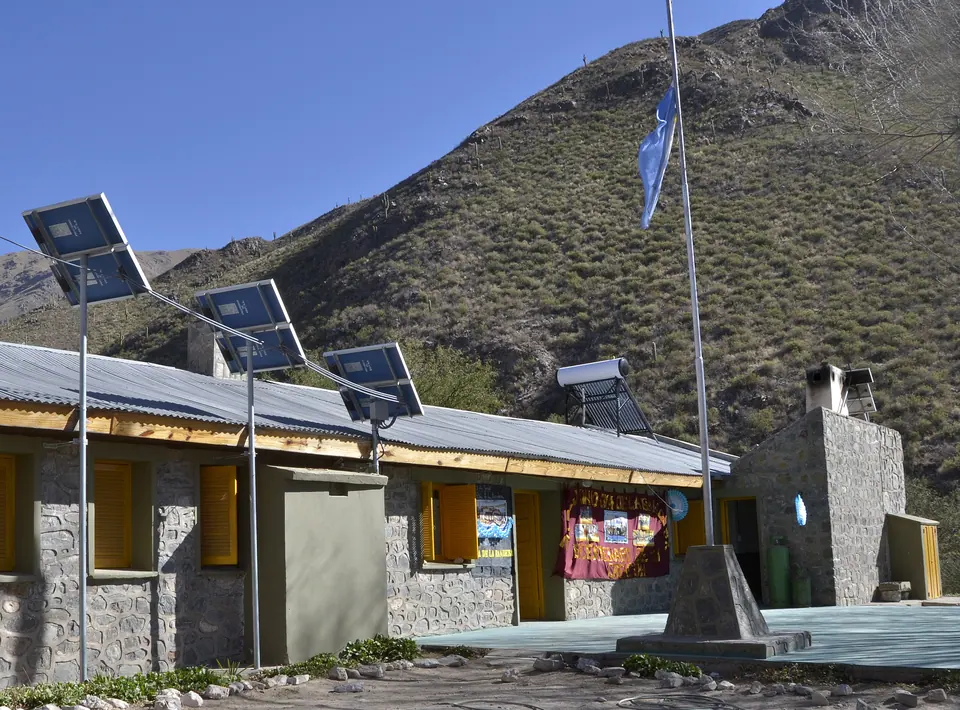
In a photograph taken in 2012, solar panels stand beside a rural school in Argentina. The PERMER programme installed renewable energy systems for schools, households and other facilities in rural areas. The picture shows where autonomy begins. To find out how long it lasts, we need to follow the cable to the equipment it powers.
At a community support point, keeping an archive of local information available calls for a different decision from keeping a device connected to the outside world. Backup runtime becomes a precise idea once it refers to a task, a length of time and the equipment the task depends on.
Two questions before opening the box
Power, measured in watts, tells us how quickly a device is using energy at a given moment. Energy, measured here in watt-hours, adds up that use over time. A hypothetical 5 W lamp running for two hours uses 10 Wh. A 5 W load running for twelve hours uses 60 Wh. A power rating on a label cannot tell you how long an installation will run.
A battery has limits on the power it can deliver and the usable energy it stores. Conversion losses, temperature, ageing and standby consumption can reduce what reaches the equipment. If several devices start at once, the short-term power limit can matter too.
Sources in this section 2
What keeps working at night
Photovoltaic output changes with the hour, cloud cover and shade. Supplying loads independently of the grid requires suitable equipment and configuration. Panels on a roof do not by themselves establish that a building will have electricity during a blackout.
In a preparedness exercise, the list of tasks tells you what to measure. How long can people get to local information? Do they need a live connection to the outside, or will a saved copy do? Which devices draw on the same reserve? The answers let a community discuss runtime in terms of the service it gets.
One reserve, three possible services
Imagine a usable reserve of 120 Wh and three constant loads chosen for illustration. A 5 W reading light would run for 24 hours on paper. If the same service also needs an 8 W local access point, the resulting 13 W cuts the estimate to just over nine hours. Add a 12 W link to the outside, and the combined 25 W leaves four hours and 48 minutes.
The estimate divides usable energy by average power. It is not a prediction for this equipment or any other installation. It assumes the stated energy reaches the devices, no new generation and steady loads. A team can measure standby power, observe one complete task and record the operating mode, initial energy, duration and what ceased to be available.
The manual for NREL’s REopt tool explains how to model outages with specified critical loads. The start time and the load profile can change the answer. In a shelter, a local copy of a map or information sheet may remain useful after the external link has gone. The saving depends on which device can be switched off while keeping the task possible.
| Service | Total power | Theoretical runtime |
|---|---|---|
| Reading light | 5 W | 24 h |
| Light and local network | 13 W | 9 h 14 min |
| Light, local network and external link | 25 W | 4 h 48 min |
The photograph shows the installation. Runtime takes a measurement.
The photograph in this feature came from the PERMER programme. The sources describe the programme’s purpose and explain how solar generation and storage work together. The magazine did not measure how long the installation in the photograph can run.
A low-risk exercise can use reading materials and non-critical equipment. Record the observed power and the time when each task stops being available. The exercise becomes more valuable when someone else can repeat the same sequence and tell what changed.
Sources and references
- Governo argentino · PERMER renewable energy programme
- Departamento de Energia dos EUA · Solar energy and storage basics
- Departamento de Energia dos EUA · Solar energy and resilience
- NREL · NREL REopt manual and outage scenarios
Sources reviewed on .